Movie Review
The Birth of a Nation
The Fiery Cross of the Ku Klux Klan!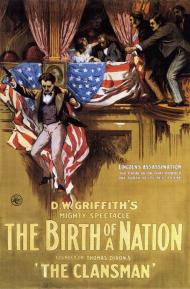
US Release Date: 03-03-1915
Directed by: D.W. Griffith
Starring▸▾
- Lillian Gish, as
- Elsie Stoneman
- Mae Marsh, as
- Flora Cameron
- Henry B. Walthall, as
- Col. Ben Cameron
- Miriam Cooper, as
- Margaret Cameron
- Mary Alden, as
- Lydia Brown
- Ralph Lewis, as
- Austin Stoneman
- George Siegmann, as
- Silas Lynch
- Walter Long, as
- Gus
- Robert Harron, as
- Tod Stoneman
- Wallace Reid, as
- Jeff the blacksmith
- Joseph Henabery, as
- Abraham Lincoln
- Elmer Clifton, as
- Phil Stoneman
- Josephine Crowell, as
- Mrs. Cameron
- Spottiswoode Aitken, as
- Dr. Cameron
- George Beranger, as
- Wade Cameron
- Maxfield Stanley, as
- Duke Cameron
- Jennie Lee, as
- Mammy
- Donald Crisp, as
- Gen. Ulysses S. Grant
- Howard Gaye, as
- Gen. Robert E. Lee
- Eugene Pallette as
- Union Soldier

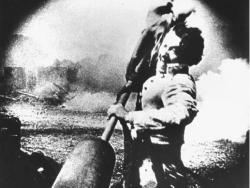
Henry B. Walthall in an iconic battle scene.
The year 1914 marked the true beginning of Hollywood as a household name. That year saw the release of the first feature length movie shot in the burgeoning movie colony, Cecil B. DeMille’s The Squaw Man. It also marked the movie debut of Charlie Chaplin and his Little Tramp persona. During the summer and fall of that year D.W. Griffith filmed the first Hollywood epic, The Birth of a Nation.
Birth of a Nation was originally titled The Clansman after a famous novel and play of the times written by a self-proclaimed white supremacist named Thomas F. Dixon Jr. Griffith later changed the title to be less offensive and more representative of the scope of his movie. It tells the story of two families, one from the north, one from the south, and how their lives intertwine before, during and after the American Civil War. The first half of the movie is by far the best. There are some truly spectacular battle scenes staged on a scale never before seen in American film. The first act culminates with the assassination of President Lincoln. The recreation of this historic event is perhaps the finest sequence in the entire 3 hour movie.
The second act deals with Reconstruction in the most repugnant and deplorably racist manner. The Ku Klux Klan are shown as the heroes riding to the rescue against insolent, unruly blacks and mulattoes who are clearly the villains; some of them actually (Gasp!) want to marry white women. The scene at the South Carolina House of Representatives is disgusting in its stereotyping. It shows the black elected officials drinking alcohol, eating fried chicken, sitting with their shoes off and just basically acting ignorant. The entire point of the scene is to demonstrate just how incapable of governing the blacks were, in Griffith’s opinion.
D.W. Griffith was from the south and had grown up listening to his father (an officer in the Confederate Army) tell tales about the war. He would later claim not to be a racist and made movies such as Intolerance and Broken Blossoms in an attempt to change his reputation as such. I first watched this movie about 10 years ago. To be honest I have put off reviewing it because I find it so distasteful. I’m glad I will never have to sit through it again. Perhaps the worst insult to blacks, in a nearly constant stream of them, is the fact that most of their large roles are played by white actors in horrible black face.
This is the movie that made Lillian Gish a star. She was the finest dramatic actress of the silent era. She could convey great depths of emotion with her face. As her friend Lily Tomlin once remarked, “It was like her aura was being filmed.” She is a ray of sunshine in a sea of demeaning images.
The Birth of a Nation became instantly notorious upon its release in 1915. The NAACP and other civil rights groups mounted protests, several riots broke out at screenings and it reinvigorated the Ku Klux Klan, which had been dormant during the beginning of the century and would later peak in membership in 1925. One of the subtitles has one white character say to another something about “Reclaiming our Aryan birthright.” If they had financed the movie themselves it is difficult to imagine a more perfect recruiting tool for the KKK.
There’s no denying, however, that it was hugely popular with the majority of Americans. It cost half a million dollars to make and went on to gross 10 million. It remains the highest grossing silent movie of all time and was the box office champ until another civil war picture called Gone With the Wind was released nearly a quarter of a century later. For all its technical accomplishments, historical importance (President Woodrow Wilson famously said, “It was like history written with lightning.”) and huge box office receipts, The Birth of a Nation is the most relentlessly racist movie ever to come out of Hollywood.
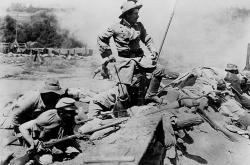
D.W. Griffith's The Birth of a Nation.
Roger Ebert wrote about this film, "The Birth of a Nation is not a bad film because it argues for evil. Like Riefenstahl’s The Triumph of the Will, it is a great film that argues for evil. To understand how it does so is to learn a great deal about film, and even something about evil." He makes a very good point. If this were a bad movie by some untalented hack, it wouldn't matter. Instead, it was made by arguably the greatest director of his era, at the top of his game. That's the conundrum of it. It's a work of art that just happens to also be the most racist mainstream film every produced in Hollywood.
As Patrick said, the first half of the film is definitely the better half. The battle scenes contained within almost make up for all the other flaws. The wide shots of the war are particularly impressive. There are seemingly several battles going on at once, both in the foreground and background with literally hundreds of extras, guns, explosions and all of it really happening right there at once on the screen without the aid of any of today's technological advances.
The other impressive scene in this half is, as Patrick also mentioned, the assassination of Lincoln. It's faithfully reproduced in detail. It even shows Lincoln's bodyguard leaving his post so that he could watch the play, which was a detail I was previously unaware of before seeing this movie and had to look up online to verify it actually happened.
Once the Reconstruction begins, the story starts to lose its way. Griffith grew up listening to stories from his father and uncle who both served in the Confederate army and clearly his views were influenced by them. According to Lillian Gish's biography, when Griffith was accused of being anti-negro, he replied, "To say that is like saying I am against children, as they were our children, whom we loved and cared for all of our lives." That simple, arrogant statement says so much about Griffith's views and how little he understood why his depiction of African Americans has offended so many.
His portrayal of blacks, whites and the KKK were much less universally controversial in 1915 than they are now, and protests by the NAACP did little to hurt the fim's box office success. As Patrick said, this was the highest grossing film of all time until Gone with the Wind. In an era when movie tickets generally cost 5 to 10 cents, theaters were able to charge $2.00 for tickets to this film. It's hard to argue that audiences didn't get their money's worth, given the amount of spectacle Griffith packs into its 3 hour running time.
Such is the power of this movie and Griffith's reputation that the controversy surrounding it has never really gone away. In 1992, the National Film Preservation Board registered The Birth of a Nation on the basis of its "cultural, historical, and aesthetic importance," and in 1999, the American Film Institute ranked it among the top 100 movies of the century. Both actions prompted protests. Also in 1999, the Director's Guild of America removed Griffith's name from its lifetime achievement award because they said he promoted, "intolerable racial stereotypes".
To simply whitewash over Griffith's place in the history of cinema however, is wrong. If he hadn't been so talented and important in the development of filmmaking as an art form, this movie would long have been forgotten. It's a film flawed by racism, but even with that, it's still a masterpiece of early cinema.
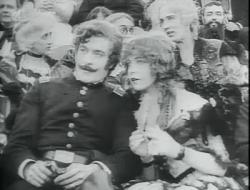
Fords Theatre, April 14, 1865.
The Birth of a Nation is a three hour black and white, silent, historical drama. In other words, it is a chore to get through. It reminded me of the time I tried to read "Mein Kampf." I was often bored, sometimes confused and the only memorable parts are the ones that feature bigotry.
It seemed to me that Griffith made a point to make The Birth of a Nation long for no other reason than for length. There are several characters too many and he drags everyone's story out. There are several large battle scenes, but outside of them the pacing is often at a crawl, or at least a leisurely stroll.
Griffith fails on the gore. When a girl jumps off a cliff, she falls a good hundred feet and lands on some boulders. She stays alive long enough for a guy to climb down and hold her in his arms. Her only visible sign of injury is a trickle of blood from her mouth, when she should have been nothing but a dress filled with bloody broken bones. Later, an arrogant cracker gets shot twice by some uppity niggers, first in the back and then in the front. Neither gun shot leaves a wound or produces any blood.
That is not the film's only flaw. I have to ask one simple question of Griffith. What in the name of Abraham Lincoln was he thinking when he hired white actors to play blacks? None of them are convincing and since he also used actual African American actors, the white impersonators seem all the more ridiculous, as well as pointless.
Possibly because I recently watched Spielberg's Lincoln, I found the most fascinating scene to be the one featuring the assassination. Like Scott, I looked this up and found some interesting facts about the bodyguard, John Frederick Parker. It is almost cause for a conspiracy that this former policeman was given that assignment. His record shows that prior to that night, he was reprimanded for conduct unbecoming an officer, using foul language and being drunk on duty. He was even charged with sleeping on the job when he decided to take a nap on a streetcar instead of walking his beat. He also had to face a board of enquiry because he frequented a whorehouse.
Not only did he move his seat so he could watch the play, but during intermission he joined Lincoln’s carriage driver and footman for some drinks in the Star Saloon next door to Ford’s Theater. It is not known if Parker was at his seat watching the play or still in the saloon when Booth shot Lincoln. Parker was never convicted of any crime and retained his job.
The harshest punishment he possibly received came via Mrs. Mary Lincoln. According to Elizabeth Keckley, Mrs. Lincoln’s dressmaker and former slave, Mary addressed Parker when he came on duty days after the assassination, “So you are on guard tonight,” Mrs. Lincoln yelled, “on guard in the White House after helping to murder the President.” Parker attempted an apology, but Mrs. Lincoln made it clear that she would always consider him guilty and ordered him from the room. Spielberg should have included that scene in his movie.
While researching this, I came across something that explained a moment in this film. Just before Booth shoots Lincoln, Lillian Gish spies and recognizes him. She even points him out to her date. My first thought was how would she know who he was, but I discovered that Booth was quite a locally famous actor. Lincoln had even attended one of his prior performances.
I apologize for wandering off the topic of the film at hand, but I was far more interested in my researching history than Griffith's interpretation of it. This may have been a masterpiece when it came out and may still be a historically important film, but its value as entertainment has greatly diminished.
Photos © Copyright David W. Griffith Corp. (1915)